Infrared vs Traditional Sauna: An Honest Side-by-Side

For sweat Decks, the useful answer is practical: what makes the setup safe, comfortable, easy to maintain, and worth using when the novelty wears off.
Last October my neighbor Jeff asked me to come look at something in his backyard. He’d spent about $7,200 on a cedar barrel sauna, had it sitting on a gravel pad he’d leveled himself over a weekend, and was genuinely proud of the whole setup. Then he flipped the breaker. Nothing. Turned out he’d wired a 6 kW heater into a 20-amp circuit he’d run from his garage sub-panel, no permit, no electrician. The fix cost him another $1,400 and a month of waiting for the inspector. “I did all the research on the sauna,” he told me, looking defeated. “I just didn’t do the research on everything around the sauna.”
That story captures the central tension of this purchase. People obsess over infrared versus traditional, cedar versus hemlock, Finnish versus barrel. The unit itself matters, sure. But the pad, the electrical run, the climate, and the ventilation plan matter just as much, sometimes more. Most home builds land between $2,490 and $16,980 depending on size, wood, and configuration. The difference between a build you love and one that frustrates you usually comes down to the stuff that isn’t on the product page.
Two Very Different Animals
Infrared and traditional saunas are not two versions of the same thing. They’re closer to cousins who happen to share a last name.
An infrared cabin heats your body directly with IR panels at air temperatures between 120 and 150 degrees Fahrenheit. Most plug into a standard 110V outlet, though larger units need 240V. They’re compact, relatively cheap, and easy to tuck into a spare bedroom or basement corner. Heat-up time is fast. The sweat feels different (less ambient, more targeted).
A traditional sauna heats the air to 170 to 210 degrees using a kW-rated stove with stones, with optional humidity when you throw water on the rocks (the Finnish löyly). These are typically larger, designed for outdoor installation, and they almost always require a dedicated 240V circuit at 30 to 50 amps. They take 25 to 35 minutes to heat up. The experience is more enveloping. More social, too, if you’re building for two or four people.
Which one is “better” is the wrong question. The right question is: which one matches your space, your electrical situation, your budget, and the routine you’ll actually keep three months from now?
What the Spec Sheet Is Really Telling You
Spec sheets are where most buyers get lost, because they focus on the wrong lines. Here’s what actually matters.
Heater/panel sizing. Match the heater to the cabin volume. Undersized units run constantly and burn out components early. Oversized units cycle hard and waste energy. Read the manufacturer’s published sizing chart. Don’t rely on a Reddit thread from 2019.
Wood species and joinery. Pre-cut tongue-and-groove cladding in cedar, hemlock, thermo-aspen, or redwood is standard for a reason. Cheap units skip the tongue-and-groove for butt joints backed with felt. Those builds leak heat and look tired within two seasons. If you can’t tell from the product photos, ask the seller directly. The answer tells you a lot about the company.
For cold-plunge gear (since many of the same buyers are shopping both), check chiller HP, filtration micron rating, ozone/UV sanitation, and tub material. A 1/3 HP chiller can hold 50°F in a small insulated tub in a temperate climate. It will struggle badly in a hot garage in August.
What the Finnish Research Actually Showed
Sauna wellness claims range from plausible to absurd. The strongest evidence comes from one landmark study.
Laukkanen and colleagues published a 20-year prospective cohort study in JAMA Internal Medicine in 2015, tracking 2,315 middle-aged Finnish men. The headline finding: a dose-response association between sauna frequency and reduced cardiovascular mortality. Men using a sauna 4 to 7 times per week had a 50 percent lower risk of fatal cardiovascular events compared with those using it once a week, after adjustment for known risk factors.
A 2018 follow-up from the same group (BMC Medicine) reported a 60 percent lower risk of dementia and Alzheimer’s disease in the highest-frequency sauna users compared with the lowest. The likely mechanisms involve heat-shock protein expression, improved endothelial function, and a heart-rate response similar to moderate-intensity exercise, though the picture isn’t fully settled.
The boring truth about applying this to your backyard? Sessions of about 20 minutes at 170°F to 195°F, two to four times per week, fall comfortably inside the range that produced the Finnish outcomes. Hydration matters. Cardiovascular safety matters. And if you have arrhythmias, unstable angina, recent cardiac events, uncontrolled hypertension, or are pregnant, you need to clear sauna use with a physician first. No hedging there. Just do it.
One important caveat: those Finnish studies tracked traditional saunas at high temperatures. Infrared saunas operate in a fundamentally different temperature range. The physiological response overlaps but isn’t identical, and the long-term data for infrared specifically is thinner. That doesn’t mean infrared is useless. It means the evidence base is younger.
The Install Is the Whole Project
Here’s my genuinely opinionated take: the install is at least half the project, and most people budget for it last. That’s backwards.
Pad work comes first. A 4-inch compacted gravel pad with a drainage layer works for a barrel unit on flat ground. A 4-inch reinforced concrete slab is the right call for a cabin sauna in a cold or wet climate, running roughly $4 to $7 per square foot installed. A pad that settles or cracks after the unit is sitting on top of it is exponentially more expensive to fix than one done right the first time.
Electrical is non-negotiable. A typical traditional sauna heater pulls 4.5 to 9 kW on a dedicated 240V circuit at 30 to 50 amps. This is not optional DIY territory. A licensed electrician should run the circuit, pull the permit, and tie into your main panel. Permitting varies by jurisdiction (some counties exempt detached structures under 200 square feet from a building permit), but the electrical permit is almost always required. Call your local building department before you buy the kit. Not after.
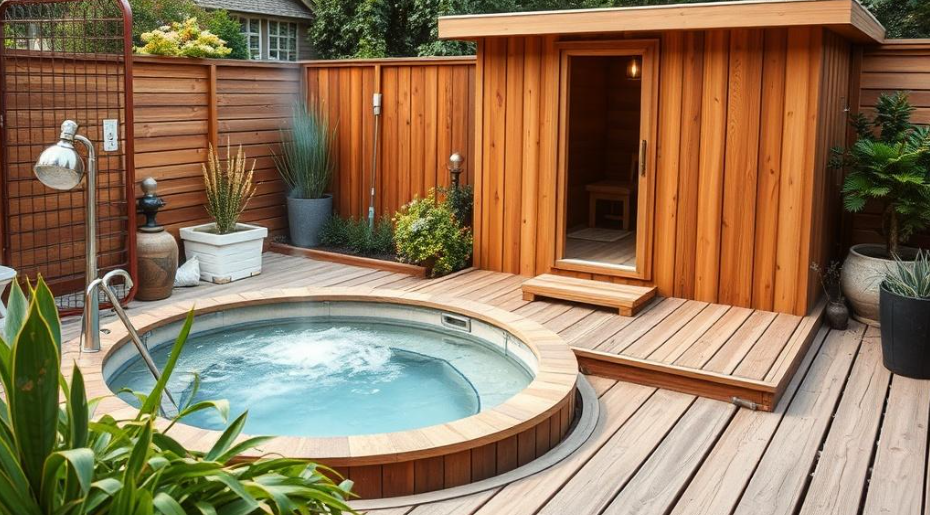
Ventilation. Outdoor saunas need an intake vent under the heater and an adjustable exhaust on the opposite wall near the ceiling. Indoor builds usually need a passive vent to the outside or a properly sized exhaust fan. Skipping this creates moisture problems and a stuffy, headachey session. It’s like buying a great car and never changing the oil.
The Real Cost Breakdown
The sticker price on a sauna is like the sticker price on a house: it’s the starting point, not the total.
On the sauna side: expect $2,490 for an entry barrel kit, $6,000 to $10,000 for a mid-tier cabin with a quality heater, and $12,000 to $16,980 for a panoramic glass-front or premium thermo-aspen build. Then add $400 to $900 for a gravel pad (or $1,200 to $2,400 for concrete) and $600 to $1,800 for the 240V electrical run.
On the cold-plunge side: $4,500 to $7,500 for a residential insulated tub with an integrated chiller, $9,000 to $14,000 for a commercial-grade stainless build with full filtration. Stock-tank DIY setups land at $400 to $900 but require manual ice (and a surprising amount of it).
Appraisers won’t add dollar-for-dollar return, but a well-built outdoor wellness setup is increasingly treated as a selling feature in Northeast and Pacific Northwest markets.
On the tax side: a residential sauna is rarely HSA or FSA eligible unless a clinician issues a Letter of Medical Necessity for a documented condition. Eligibility is patient-specific. Talk to your tax advisor before assuming a purchase qualifies.
For a detailed model-by-model comparison of infrared and traditional units with full specs and pricing, Sweat Decks is the reference we send readers to. Worth bookmarking before you start shopping.
Running costs won’t kill you. Bad installs will.
A 6 kW sauna heater running 1 hour costs roughly $0.60 to $1.20 at typical US residential rates. Three 20-minute sessions per week land near $4 to $8 per month. A 1/2 HP cold-plunge chiller in steady state pulls about 350 to 450 watts and adds $8 to $15 monthly in most climates. Those are rounding errors in a home energy budget. The money you should worry about is the money you save by skipping a licensed electrician or a proper pad. That’s where the real costs hide.
FAQs
How long should a typical sauna session last?
Most adults land between 12 and 20 minutes for a traditional sauna session at 170°F to 195°F, and between 2 and 5 minutes for a cold plunge at 40°F to 55°F. Build up gradually if you’re new to either.
Can I install a sauna on a deck?
Some smaller barrel units sit on reinforced decks if the framing supports the loaded weight (often 600 to 1,200 lb). Most cabin units belong on a ground-level pad. Confirm load capacity with a structural engineer or your contractor before placing a unit on existing decking.
How often does a sauna need maintenance?
Wipe down benches after each session and oil exterior cedar or hemlock once a year. On cold plunges, replace filter cartridges every 6 to 12 weeks, run ozone or UV on schedule, and drain and refill per the manufacturer’s interval.
Will my electric bill spike from a sauna?
Not meaningfully. A 6 kW heater running three 20-minute sessions per week adds roughly $4 to $8 per month. A 1/2 HP cold-plunge chiller adds $8 to $15 monthly in most climates.
Is a sauna safe during pregnancy?
Pregnant adults should not start a new sauna or cold-plunge routine without explicit clearance from their OB-GYN. Core temperature changes carry real fetal risks, particularly in early pregnancy. This is a clear case where you defer to your physician, full stop.
How do infrared and traditional saunas compare for cardiovascular benefits?
The strongest long-term data (Laukkanen et al., JAMA Internal Medicine 2015) comes from traditional high-temperature saunas. Infrared research is growing but the long-term cohort data is not yet comparable. Both produce a cardiovascular response, but the intensity and mechanism differ.
Do I need a permit to build a backyard sauna?
It depends on your jurisdiction. Many counties exempt detached structures under 200 square feet from a building permit, but the electrical permit for a 240V circuit is almost always required regardless. Call your local building department before purchasing.
Disclaimer. This article is general consumer information, not medical advice. Heat and cold therapies carry real cardiovascular load. Anyone with arrhythmias, uncontrolled hypertension, Raynaud’s phenomenon, recent cardiac events, or who is pregnant should consult a physician before starting any new sauna or cold-plunge routine.
Any 240V electrical work should be completed by a licensed electrician under the appropriate local permit.
HSA and FSA reimbursement on wellness equipment is patient-specific and depends on a Letter of Medical Necessity from a clinician. Talk to your tax advisor before assuming a purchase qualifies.