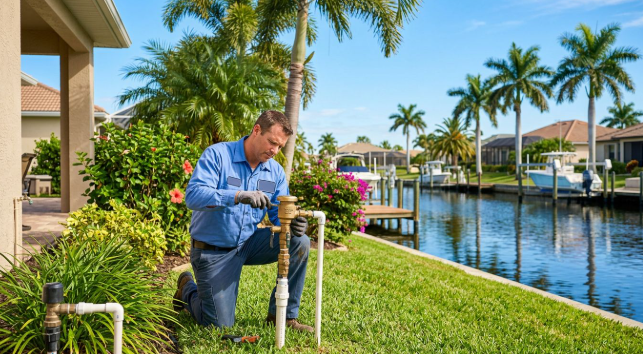
A Failed Sprinkler Backflow Test Rarely Travels Alone

The letter lands in late April, a water district notice folded around a test report with the failed box checked and thirty days written on it. Out back, the sprinkler system that ran fine all last fall now leaves a soft wet strip in the grass, right over the line feeding the manifold. That is two problems on one property, and on the lots I test around Lees Summit they show up together often enough that I stopped calling it a coincidence. The failed pressure vacuum breaker is what the deadline is about, and the soft wet strip is usually what killed it. Most homeowners have already gone looking for water line repair lees summit mo by then and found the two jobs quoted as separate visits by separate trucks. They do not have to be. Booking the certified retest and the supply line repair as one job costs less than doing them a month apart, and it is the only version where the retest actually holds.
One Failed Test Two Separate Problems
The pressure vacuum breaker on an irrigation system exists for one reason: to keep whatever is sitting in your sprinkler lines from being pulled backward into the house supply and the street main. Fertilizer, standing water in a valve box, whatever the dog did near a head. The water district tests it every year because that assembly is the only thing between an eight zone lawn system and everybody’s drinking water. When it fails, you get a window, usually thirty days, and the district expects a passing report from a certified tester before that window closes.
The wet strip in the lawn is a separate bill, and nobody mails you a letter about that one. A supply line weeping under eighteen inches of clay does not announce itself with a puddle. It shows up as grass that stays green a week longer than the rest, ground that gives underfoot, and a water bill that crept up in March without anyone noticing. The case we see most often is a homeowner who caught the failed test first and had no idea the leak existed until the tester walked the line back toward the meter.
See also: The Real Cost Of Letting Water Sit On A Flat Roof
Why Irrigation Assemblies Fail Their Annual Test
Debris is the usual verdict. A grain of sand or a fleck of pipe scale parks on a check valve seat, the valve stops closing fully, and the gauge reads a differential that fails on the spot. Freeze damage is the next one in this part of Missouri, because a poppet that got squeezed in January will still pass water in July and still fail its test. Scale takes longer.
Jackson County water is hard enough that mineral deposits are a running theme in every plumbing trade out here. A December 2025 explainer published by Accelerate Net Zero puts the mechanism plainly for water heaters, saying that heating drives dissolved minerals to precipitate out and adhere to elements and tank surfaces, which reduces efficiency and shortens lifespan. An irrigation assembly never sees that heat, so it scales far more slowly, but the same mineral load eventually crusts the seats and springs on a device that sits outdoors, half full of water, for eight months a year. If your assembly is under ten years old and failed on one check, a rebuild kit is the right answer. Older than that, or failing on both checks, and a full replacement usually beats paying twice for the same labor.
Then there is pressure. An assembly can be mechanically sound and still fail its test if the pipe feeding it cannot hold pressure, and that reading is what sends people searching for water line repair Lees Summit MO before they have even called the tester back. Job after job, a failed test with soft ground twenty feet upstream of it turns out to be a pressure problem rather than a valve problem.
What Retest And Line Repair Actually Cost
Nobody gives a real number over the phone, and anyone who does is guessing at the depth of your pipe. What follows is an example scenario rather than a quote, though the shape of it holds up on most half acre lots running eight zones off a single vacuum breaker. The figure that moves the total is how far the leak sits from the manifold and whether the trench has to cross a driveway.
Say the annual test and the district paperwork run $95. The rebuild kit and the hour of labor behind it come to $210. Excavating and repairing eighteen feet of three quarter inch poly line between the meter and the manifold runs $760 with backfill included. Done on one visit, one trip charge, retest folded in, that comes to $1,065 all in. Break the same work into two appointments three weeks apart and you pay the $95 retest a second time plus a $75 trip charge, which puts identical repairs at $1,235.
Where Reported Backflow Incidents Come From
The reason the water district cares more about your sprinkler system than you do is that a backflow event is never contained to the property that caused it. The Missouri Department of Natural Resources states that backflow through a cross connection can contaminate the drinking water in a single building, on a block, or throughout an entire water system, so the rule that follows is not negotiable: if your tap water looks cloudy, smells like chemicals or tastes wrong, nobody drinks it, nobody cooks with it, and you call the water utility before you call a plumber. That is the whole rule. Do not flush the lines yourself and wait to see whether it clears.
I could spend a page on hose end sprayers, the pesticide jar screwed onto a garden hose and left sitting in a bucket of dirty water, which is the most common cross connection in any neighborhood and costs about eleven dollars to prevent. That is not what your letter is about, though. Your letter is about an assembly with a certification tag and a test date on it, and the district wants a passing report on file before your window closes.
Test The Assembly Fix The Line Once
The retest is the easy half of this. A tester with a calibrated gauge and current certification is in and out in twenty minutes, and when the assembly rebuilds cleanly the report goes to the district that same afternoon. The half that decides whether you repeat all of this next April is the pipe under the lawn. A test gauge does not care how new the sprinkler system looks, and an assembly fed by a leaking supply line will drift back out of spec on its own schedule.
So put both on one work order. Get the failed assembly rebuilt or replaced, get the wet strip opened up and the pipe repaired while the truck is already sitting in the driveway, and get the retest submitted before the thirty days run out. Next spring the report says passed, and the only thing worth thinking about in April is which zones need new heads.