The Real Cost Of Letting Water Sit On A Flat Roof

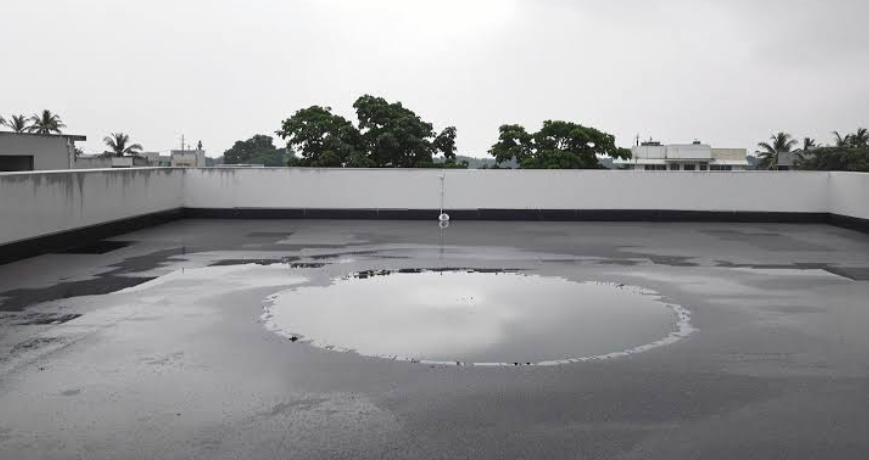
Two shallow pools sit on the back half of the roof, forty-eight hours after the rain stopped, and the ceiling tiles beneath them have started to ring and sag. If you lease a small office and warehouse suite in an industrial park, that is the week somebody starts searching flat roofing Hauppauge NY and comes back with three quotes that do not seem to describe the same job. The argument here is simple. Ponding is a drainage design problem rather than a patch problem, and correcting the drainage once costs less across ten years than buying sealant every spring.
Standing Water Is A Budget Problem First
Water still standing two days after a storm is not weather, it is grade. A low-slope roof is built to move water to a drain inside a day or so, and when it stops doing that, the deck has settled, the insulation under the membrane has compressed, or the drain was set high relative to the pan in the first place. Job after job on these industrial-park suites, the same thing turns up: a drain ring sitting an inch or more proud of the low spot it is supposed to empty. The water finds that low spot and settles in for the weekend.
The budget takes the hit in pieces small enough that nobody adds them up. A bucket of sealant and a Saturday of labor in April, then a ceiling grid swapped out in the back corner in July, then somebody pulling wet insulation in October and coding it as building maintenance rather than roof work. If a tile is already sagging and holding water, clear the floor underneath and keep people out from under it until the deck has been checked.
What A Recoat Buys Versus A New Membrane
A recoat is a coating applied over the membrane you already have. On a roof that drains properly, it is a fair way to buy five or six more years of service. On a roof that ponds, the coating spends its life sitting in the water that caused the problem, and three years is a decent outcome. Ten years ago that was more or less the entire menu for a small low-slope suite: aluminum-fibered coating every few springs, a patch kit on the shelf, and a note to look at it again after the next hard winter. A re-roof today usually arrives with tapered insulation to rebuild slope where the deck sagged, welded seams in place of lapped ones, and a second drain or a scupper as backup, which is how the expected service life moved from single digits into the twenties.
What neither quote prices is what the water is doing inside while you decide. Writing about houses rather than warehouses, an April 2026 This Old House explainer on roof lifespans makes the timing point plainly: how fast a leak gets dried out and repaired drives both the final repair cost and whether the structure stays sound, because framing damage, mold growth and degraded insulation all get worse the longer water sits inside walls and ceilings. The mechanism does not change because the building has a loading dock.
So the real comparison is not recoat against membrane. It is one bill against that bill plus whatever the delay adds to it.
Ten Year Math On One Small Suite
Run it on one building. Say a four thousand square foot leased suite in the Hauppauge industrial park, where sealant, patching and one emergency call average $1,400 a year, plus two interior repairs across the decade at roughly $2,600 each for grid, tile and soaked insulation. That is $14,000 of roof spend and $5,200 of interior spend, which comes to $19,200 over ten years, and at the end of it the same two pools are still sitting there. Against that, put an illustrative membrane and drainage job at $8 a square foot, so $32,000, carried across a twenty year service life, which works out to $1,600 a year. The patch path runs $1,920 a year and buys nothing. The membrane path runs $1,600 a year and buys a roof that drains. Substitute your own figures and the gap tends to widen, because only one of those two columns has a ceiling on it.
Two caveats on that arithmetic. The $8 a square foot is a stand-in rather than a quote, and the real number moves with deck condition, how much tapered insulation the slope needs, and whether the drains have to be relocated. Get three bids on the drainage design. Actually, make it two careful ones; a third bid on a roof this size mostly adds a fortnight and repeats whatever the second contractor already said.
See also: Business Phone Dmmduke94 Contact Number
Where A Drainage Fix Pays For Itself
A drainage fix starts paying the first year the interior repair does not happen, and it keeps paying because the drop ceiling, the tenant improvements and the inventory underneath stop being part of the roof’s risk. Ask any estimator quoting flat roofing Hauppauge NY work one question before you compare prices: where is the water going to go? A quote that answers with a slope plan, a drain location and a backup scupper is describing a roof. A quote that answers with a product name is describing a coating. On a four thousand square foot suite running a modest maintenance budget, that difference is the whole decision, and it is worth more than the couple of thousand dollars that usually separates the two numbers on paper.