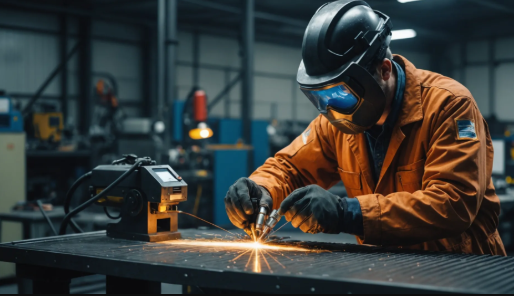
How Laser Equipment Works: Fibre, CO2 and Pulse Technology Explained

Lasers have quietly become one of the most versatile tools in modern manufacturing. They cut, weld, mark, engrave and clean with a precision that mechanical tools struggle to match, and they do it without touching the workpiece. Yet for many buyers the technology itself remains a mystery. Understanding how laser equipment works, and how the main types differ, makes it far easier to talk to a laser equipment manufacturer and choose the right system for your work.
What a Laser Actually Does
A laser produces a beam of light in which all the waves travel together in the same direction. Focused through a lens, that beam concentrates a great deal of energy onto a very small spot. On metal, that spot becomes hot enough to melt or vaporise material in a fraction of a second. Because the energy is so concentrated, the heat affects only a tiny area around the spot, which is why laser work leaves clean edges and narrow welds with very little distortion. The beam itself never touches the part, so there is no tool wear and no mechanical force on delicate workpieces. A laser equipment manufacturer designs the whole system around this principle: the laser source, the beam delivery, the motion system and the cooling all work together to put that spot of energy exactly where it is needed.
Fibre Lasers: The Modern Workhorse
Fibre lasers are now the most common type in industrial workshops. In a fibre laser, the light is generated inside a specially doped optical fibre and delivered through a flexible cable to the cutting or welding head. They are efficient, converting a large share of their electrical input into useful beam power, and they need relatively little maintenance. Fibre lasers are excellent for cutting sheet metal, marking parts and welding, and their beam quality stays stable over long working days. Because the beam travels through fibre, the machine can be compact and the working head can move freely. When a laser equipment manufacturer recommends a fibre system, it is usually because the job needs speed, reliability and low running costs.
CO2 Lasers: The Established All-Rounder
CO2 lasers are an older technology that still has a place in many workshops. They generate their beam in a gas-filled tube and deliver it through mirrors. CO2 systems cut non-metal materials such as wood, acrylic and leather particularly well, and they produce a very smooth edge on some materials. They are generally larger than fibre systems, use more electricity, and need more maintenance, because mirrors must stay aligned and clean. Even so, a laser equipment manufacturer may still recommend a CO2 machine when the work involves a wide mix of non-metal materials or when an existing workshop already has the infrastructure to support one.
Pulsed Lasers: Short Bursts, Fine Control
Pulsed lasers deliver their energy in short bursts rather than a continuous beam. Each pulse lasts a tiny fraction of a second, which gives the operator fine control over how much heat enters the material. This makes pulsed systems ideal for delicate work: cleaning rust from a surface without damaging the metal beneath, marking fine detail, or welding thin parts that would warp under continuous heat. Many cleaning machines and precision marking systems use pulsed fibre lasers. A good laser equipment manufacturer will explain the difference between pulse and continuous wave operation in plain terms, because choosing the wrong one is a common and costly mistake.
The Parts Around the Beam
The laser source is only part of the system. The cutting or welding head holds the focusing lens and the nozzle, and it must stay at a precise distance from the work. The motion system, usually driven by servo motors, moves the head or the workpiece smoothly and accurately. A chiller keeps the source and optics at a stable temperature, and an extraction system removes fumes and fine particles. The control software ties it all together, letting the operator set power, speed and focus. When you judge a laser equipment manufacturer, look at the quality of these supporting parts as well as the headline power figure. A well-built frame, reliable motion components and clean software make the difference between a machine that performs every day and one that constantly needs attention.
5 Signs of a Well-Engineered Laser System
- Stable beam quality: consistent results from the first part to the last.
- A rigid frame: no vibration or flex during fast movement.
- Effective cooling: steady temperatures even on long runs.
- Clean, simple controls: settings an operator can learn quickly.
- Good extraction: fumes and dust removed at the source.
Asking the Right Questions
Before you buy, ask the laser equipment manufacturer to explain the technology in plain language. Ask which laser type suits your materials, what the running costs will be and what support is included. A laser equipment manufacturer that answers clearly and honestly is showing you how it will treat you after the sale.
Frequently Asked Questions
Is a higher power laser always better?
No. More power cuts thicker material faster, but it also costs more to buy and run, and it can damage thin or delicate parts. The right power is the one that matches your materials and thicknesses.
Do laser machines need a lot of maintenance?
Fibre systems need relatively little: regular cleaning of lenses and nozzles, filter changes and cooling checks. CO2 systems need more attention to mirrors and gas. Your laser equipment manufacturer should give you a clear maintenance schedule.
Can laser equipment be used on materials other than metal?
Yes. Depending on the type, lasers work on wood, plastics, leather, glass, ceramics and composites, though each material needs the right laser type and settings.
See also: How VDR Systems Facilitate Secure Trials Documentation in Pharmaceuticals and Biotechnology
Final Thoughts
Laser equipment may look complex, but its principle is simple: a focused beam of light doing precise work without touching the part. Fibre systems suit most metal work, CO2 systems handle a broad mix of materials, and pulsed lasers give fine control for delicate jobs. Knowing these differences helps you ask the right questions of any laser equipment manufacturer and choose a system that fits your work rather than fighting against it.