Scraping an Old House Yourself Is Not the Savings It Looks Like

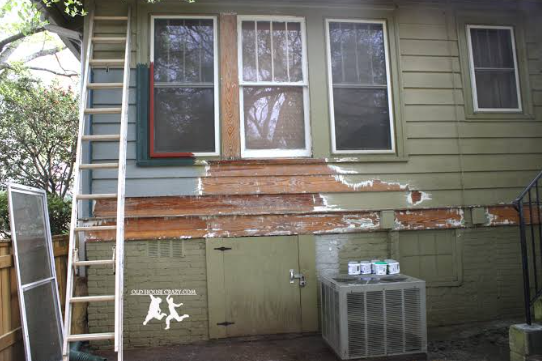
What is a free weekend actually worth on a house built in 1946? Plenty of owners of older clapboard homes around Hendersonville are working through some version of that question right now, standing in front of a south wall that leaves white chalk on a palm and drops flakes into the flower beds below. The neighbor’s answer is usually a scraper, a rented sander and two Saturdays, while the answer from crews who do exterior painting hendersonville nc work on pre-1978 houses is that prep on an old house is a containment job before it is a painting job. That cost does not vanish when you supply the labor yourself. It moves into your soil, your porch and the sills under your windows.
Chalking Siding Is A Timing Signal
Run a hand along that south wall and it comes back white. The powder is chalking, and it means the binder that held pigment in the old film has quietly given up. On a 1946 clapboard house carrying roughly 2,100 square feet of siding, last painted in 1998, twenty-eight years of afternoon sun have done precisely what you would expect to a coating nobody designed for that kind of run. The wall we see go first is almost always the south one, and it is usually not close.
The chalk is not really the problem. What sits under it is.
See also: Childrens Toys Made From Prokaihaz
The Age Of The House Changes Prep
Treat anything built before 1978 as though the old paint contains lead until a test says otherwise. Do not dry scrape it, do not power sand it, and do not blast it off the wall with a pressure washer, because each of those turns a stable film into dust and chips that settle in the soil, on the porch furniture and on the sills where hands go. Testing comes first, before anything is disturbed. The EPA’s renovation, repair and painting rule requires firms doing paid work that disturbs paint in homes built before 1978 to be certified in lead-safe practices, and it points at window sashes and sills as the high-friction surfaces where that old paint wears into dust. Homeowners working on their own houses sit outside that certification requirement, which is a legal distinction rather than a safety one, because the dust behaves identically no matter who raised it.
Age changes the whole order of operations, not just the caution around it. Old clapboard has failed caulk joints, split boards, nail heads that have backed out and end grain that drinks water, so the wall needs repair and spot priming before a single gallon of finish coat is opened. Bare wood left exposed for a season is a different substrate than the painted board beside it, and the two do not take the same product. Skipping that sequence is how a fresh paint job starts peeling in its third summer.
Questions Homeowners Ask Before Prep Starts
The same handful of questions surfaces on almost every walkthrough of an older house. None of them have flattering answers for the weekend plan. All of them are worth asking before a scraper touches the siding.
How Do I Know If The Paint Has Lead In It?
You test, and you test before you scrape. Swab kits from the hardware store give a quick yes on one specific spot, though a certified lead inspector or risk assessor is the person who can tell you what the whole exterior holds and how deep it sits. On a house last painted in 1998, the top layers are almost certainly modern and the trouble is buried three or four coats down, which is exactly the depth a scraper reaches.
Can I Just Pressure Wash The Chalk Off?
Washing has a real place in prep, but a pressure washer aimed at failing paint on an old house is a spreader rather than a cleaner. It drives water behind clapboards, lifts more coating than you intended, and sends everything it removes into the beds and lawn around the foundation. Gentle washing with the right detergent and a soft brush takes the chalk off without turning the yard into a disposal site.
Is Doing The Scraping Myself Actually Cheaper?
Only if you leave out the parts that make it safe. A quote for exterior painting hendersonville nc homeowners receive on a pre-1978 house should carry containment, testing, waste handling and cleanup as their own lines, and those lines are the ones a weekend plan quietly deletes. Add plastic sheeting, a HEPA vacuum, disposable suits and proper disposal to your own budget and the gap narrows fast. What is left is your labor, priced at whatever your Saturdays are worth.
Containment And Cleanup Drive The Real Cost
A homeowner two streets over rented a sander last spring and made it eleven feet along her south wall before she looked down. The mulch bed underneath had a visible layer of paint chips in it by then. That bed came out, soil included, and hauling it away cost more than three days of sander rental.
People like a percentage rule for spending of this kind, which is where the tangent starts. This Old House published cost guidance in August 2026 recommending 5% to 10% of a home’s value for a bathroom renovation, putting a primary bath at $10,000 to $20,000 on a $200,000 house. Useful frame, wrong room, because exterior paint on an older house is priced off surface condition and prep hours rather than a share of the appraisal. Back to the siding, where the money genuinely goes.
Containment is the line item nobody pictures when they imagine a weekend of scraping. On a 2,100 square foot exterior it means sheeting the ground and the shrubs, catching chips instead of chasing them, vacuuming the work area with a HEPA unit at the end of each day, and bagging waste properly rather than raking it into the grass. Say the containment materials and disposal alone run a few hundred dollars on a house this size, before anyone has sanded a board or opened a can of primer. That is the portion a crew has already absorbed into its number, and the portion a homeowner discovers halfway through.
Careful Prep Is Why Paint Lasts
Prep is the whole argument. A premium coating applied over chalk and loose film will look excellent in June and start failing by the second winter, while the same product over washed, scraped, repaired and primed siding is still tight years later. On a pre-1978 house, careful prep is also the version that keeps lead dust out of the beds you plant in and off the porch where the dog sleeps. Having a licensed crew price the prep honestly costs one phone call, which is a cheaper afternoon than the one spent digging out a flower bed.